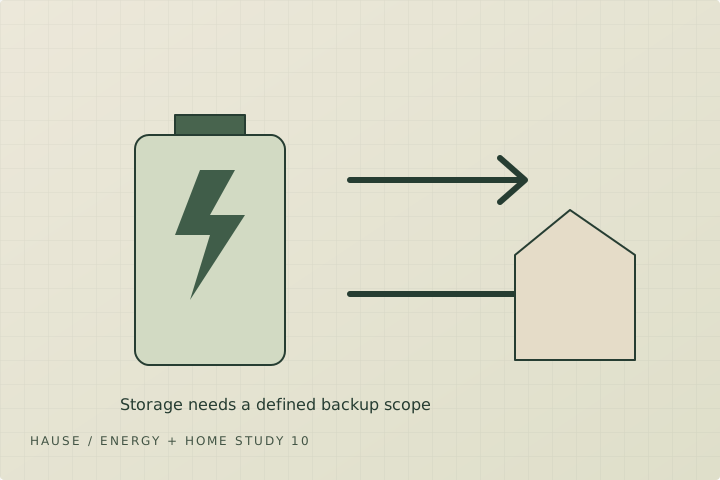
A battery size in kWh does not tell you which loads it can start or how long it will support the whole house. Begin with the outage objective: what must keep running, for how long and under which conditions. That brief is more useful than selecting the largest battery in a catalogue.
Separate energy capacity from power output
Usable battery energy in kWh describes an amount of stored energy. Power in kW describes the rate at which the system can supply it. Running power, starting demand and any supported-load restrictions all need to be checked in the actual system design.
A hypothetical 10 kWh of usable energy divided by a steady 1 kW load gives ten hours of arithmetic runtime before additional losses or reserve assumptions. That does not mean the same battery can supply every appliance, start a large motor or sustain a fluctuating whole-house load for ten hours.
Build an essential-load list
List the circuits and appliances you want to support: refrigeration, communication, selected lighting or another defined need. Record expected running power, operating pattern and any starting demand using manufacturer information or a qualified assessment. Include medical or critical needs explicitly so the designer can assess the requirement rather than assume it.
Decide what can be left off during an outage. Whole-home backup, selected-circuit backup and short-duration support are different briefs. A load plan can sometimes accomplish the objective more clearly than a larger storage purchase.
| Brief item | Question to resolve |
|---|---|
| Supported loads | Which circuits and appliances must operate? |
| Power | Can the proposed system run and start them? |
| Usable energy | What reserve and conversion losses are assumed? |
| Duration | What outage length and operating pattern are targeted? |
| Recharging | What can recharge the battery during the outage? |
Specify the backup configuration
Natural Resources Canada's planning guide distinguishes solar-system configurations, including arrangements designed for storage and essential loads. Ask for explicit backup capability, transfer/islanding equipment, supported circuits and the conditions under which the array can recharge storage during an outage.
Ordinary grid-connected generation and a designed backup system should not be treated as interchangeable. The contractor and distributor must review the electrical arrangement and any additional requirements. A calculator cannot certify the configuration or provide wiring instructions.
Keep resilience and savings as separate objectives
A battery can be considered for energy shifting, outage support or both. Price each objective and ask which assumptions create its value. A cash-savings model should include losses, operating limits, replacement assumptions and the actual tariff terms; a resilience decision may involve a different priority.
Request commissioning instructions that demonstrate the supported operating modes and a plan for alerts, maintenance and future service. Keep the battery's usable-capacity, power and warranty documents with the handover records.
- Essential loads and outage duration defined.
- Power and starting requirements reviewed.
- Usable energy, reserve and losses declared.
- Backup/transfer configuration expressly specified.
- Commissioning and service responsibilities recorded.
Sources + further reading
Source review: 2026-10-04. Requirements and programs can change; confirm the current details with the authority or provider.