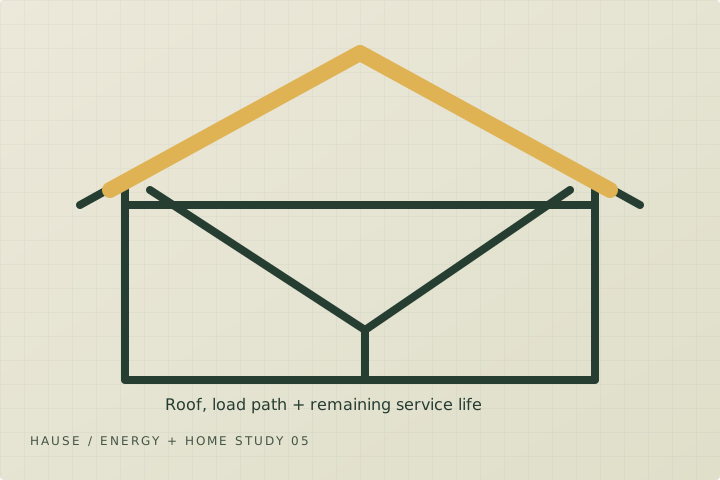
An array can outlast the roof surface beneath it. If the roof needs near-term work, installing solar first can introduce a removal-and-reinstall step. Make the roof review an early design input so the array layout and construction scope reflect the condition of the property.
Record condition without climbing
Gather roof age, product records, warranty information and a history of leaks or repairs. Take photographs from safe ground-level positions and note visible curling, damage, uneven areas or missing material. A roofer can assess conditions that are not apparent from those photographs.
Describe any planned roofing work before the solar quote is finalized. If part of the roof was recently replaced while another part is older, identify the separate areas. The best available roof plane for generation may not be the area with the best remaining condition.
Resolve the roof and structure responsibilities
Ask who reviews the roof covering and who confirms the supporting structure when that assessment is required. Module area alone does not establish an acceptable installation. The proposed equipment, attachments, existing framing and site conditions must be considered by the responsible professionals.
Request the attachment and weatherproofing approach for the specific roof product. Confirm any coordination required with the roofer or roof-warranty provider. The solar quote should identify what is included and what remains a separate assessment or repair.
Review the layout as a serviceable roof
The final design should explain how the array relates to vents, chimneys, skylights, roof edges and access needs. Ask how a future roof repair or equipment replacement would be handled. Avoid treating the maximum possible module count as the only design objective.
Review drainage, snow shedding and areas where people use the property below. These details need a site-specific discussion; a general annual-output calculator cannot assess roof safety or prescribe a setback. Ask the designer to document the applicable requirements instead of copying another roof's dimensions.
Compare the sequences before choosing one
For a hypothetical home with a worn roof and a strong solar candidate, compare roof replacement first with a combined roofing/solar project. Include removal/reinstall obligations, the workmanship boundaries and who takes responsibility if a leak occurs near an attachment.
If the roof remains in service, retain its condition record and the approved attachment plan. Keep before-installation photos so later concerns can be investigated using evidence rather than assumptions about which trade caused them.
- Roof age, product and repair history collected.
- Condition and structural review responsibilities assigned.
- Future roof work discussed before final array design.
- Attachment and roof-warranty coordination recorded.
- Service access and removal/reinstall scope clarified.
Sources + further reading
- City of Calgary: Residential solar collectors
- City of Calgary: Solar photovoltaic permit checklist
- ENMAX Power: Connect a micro-generator
- Alberta Utilities Commission: Rule 024
- Alberta Utilities Commission: Micro-generation FAQs
- Alberta Utilities Consumer Advocate: Micro-generation
- Natural Resources Canada: Solar photovoltaic energy tools
- City of Calgary: Residential solar calculator
- Natural Resources Canada: Closed Canada Greener Homes Grant
- Natural Resources Canada: Closed Canada Greener Homes Loan
- City of Calgary: Residential Clean Energy Improvement Program
- Natural Resources Canada: Planning and decision guide for solar PV systems
Source review: 2026-10-04. Requirements and programs can change; confirm the current details with the authority or provider.