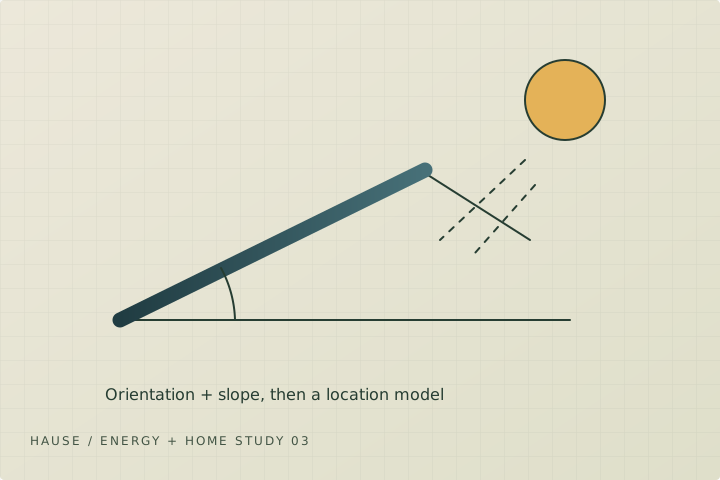
Two arrays with the same module capacity can produce different energy because they face different directions, sit at different slopes or experience different shade. A production estimate should show how it relates to the proposed layout. Ask for those assumptions before comparing headline annual output.
Identify each roof plane
Ask the designer to label the orientation, tilt and module count for each included roof area. An east-west split and a single south-facing plane can have different production timing even when annual totals are similar. That timing matters when household use and export value are being considered.
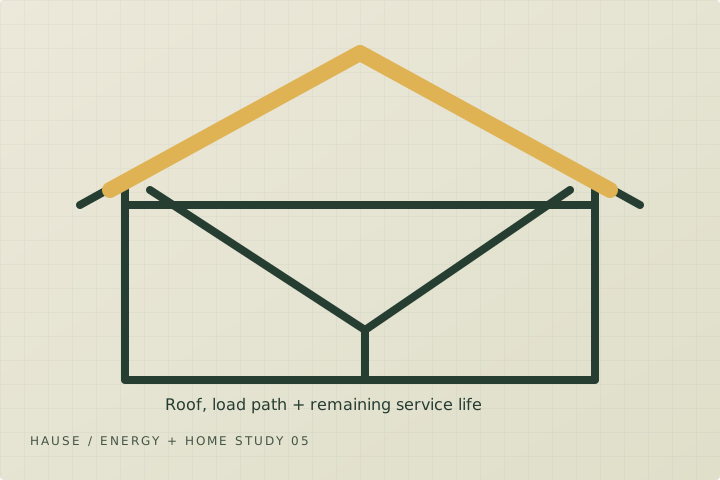
Keep current roof geometry separate from a mapping screen. New dormers, additions, vents or nearby structures may change what is possible. A regional resource or older aerial model can support screening while a current site review confirms the design.
Review shade as a changing condition
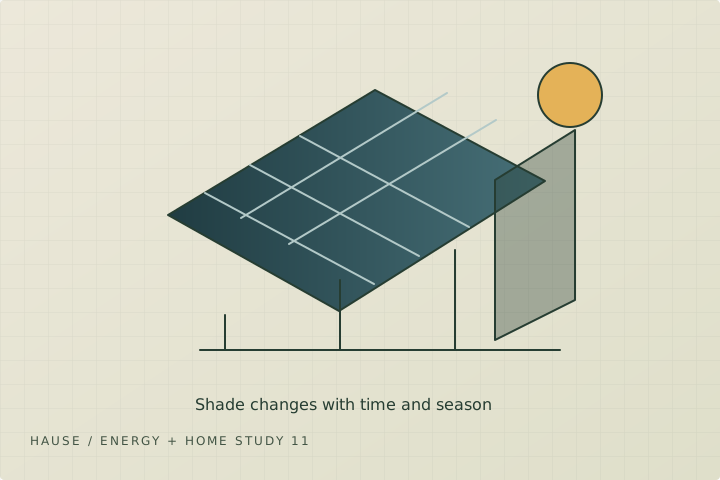
Trees, chimneys and neighbouring structures cast shade at different times and seasons. Ask how the proposed model captures those obstructions and whether tree growth or nearby development was considered. A sunny photograph taken at noon cannot establish annual exposure.
If a layout relies on removing or pruning vegetation, identify ownership and approvals before making that an output assumption. Compare a case with the current shade retained. A future action should be shown as a separate scenario until it is actually feasible and agreed.
Declare equipment and loss assumptions
Request the model's module and inverter assumptions, clipping treatment and other losses. Different modelling approaches may produce different totals from the same roof. A useful estimate explains which inputs are measured, which are manufacturer data and which are allowances.
Our annual-yield input is intended to be the final net generation per installed DC kW. If the quoted yield already includes shade and system losses, do not subtract them again. Keep an input note with the scenario so later comparisons use the same convention.
Use lower-yield cases constructively
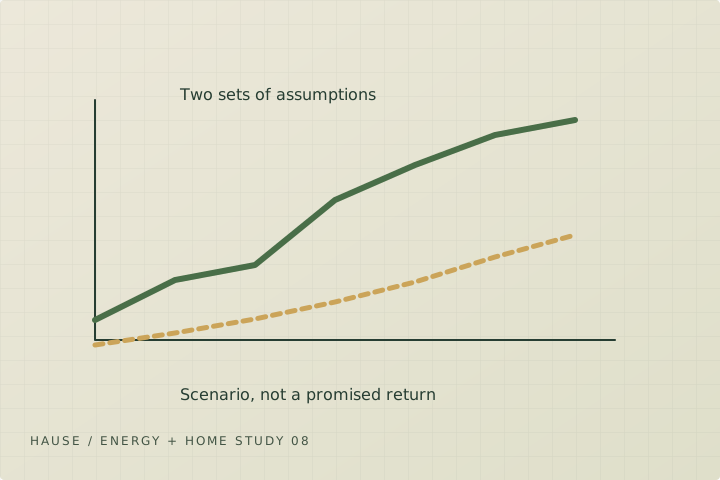
Run a conservative yield alongside the proposed base case and compare how the energy-value result changes. Then ask which field observation or model refinement would reduce uncertainty. That approach turns a disagreement about a single number into a specific request for evidence.
For a hypothetical roof with one obstructed plane, a smaller well-performing layout may be a better fit than filling every remaining space. The proposal should explain the trade-off among layout, service access, timing and annual generation rather than treating module count as the sole success measure.
- Roof planes and module allocation labelled.
- Current obstructions and future assumptions separated.
- Weather, orientation and loss inputs documented.
- No double-counted loss factor.
- Conservative yield case retained for comparison.
Sources + further reading
- City of Calgary: Residential solar collectors
- City of Calgary: Solar photovoltaic permit checklist
- ENMAX Power: Connect a micro-generator
- Alberta Utilities Commission: Rule 024
- Alberta Utilities Commission: Micro-generation FAQs
- Alberta Utilities Consumer Advocate: Micro-generation
- Natural Resources Canada: Solar photovoltaic energy tools
- City of Calgary: Residential solar calculator
- Natural Resources Canada: Closed Canada Greener Homes Grant
- Natural Resources Canada: Closed Canada Greener Homes Loan
- City of Calgary: Residential Clean Energy Improvement Program
- Natural Resources Canada: Planning and decision guide for solar PV systems
Source review: 2026-10-04. Requirements and programs can change; confirm the current details with the authority or provider.