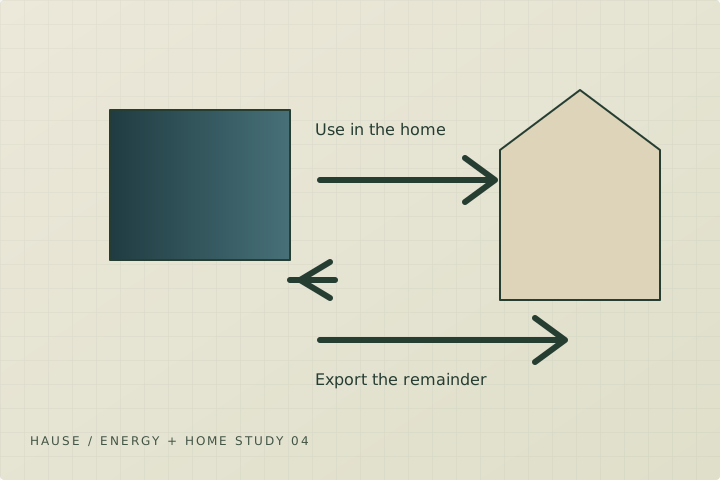
The value of solar energy depends on where it goes and when it is produced. Electricity used directly by the home can avoid purchased energy; exported electricity receives the applicable retailer credit. Treating every generated kWh as a full retail bill saving can make an early proposal look better than its assumptions justify.
Track three different energy quantities
Record generation, on-site use of that generation and exports. Imports from the grid are the household's remaining electricity purchases. The fraction of generation used on site is called self-consumption here; it is different from the fraction of household demand supplied by solar.
For a hypothetical 9,350 kWh annual output and a 40% self-consumption assumption, 3,740 kWh are assigned to on-site use and 5,610 kWh to exports. If household demand is 10,000 kWh, on-site solar supplies 37.4% of that demand in this simple model. Those figures are scenario arithmetic, not an interval-meter prediction.
Enter the value of each stream separately
Alberta's Utilities Consumer Advocate describes small-scale micro-generation as net billing, with export compensation agreed with the retailer. It also explains that delivery-related charges can continue. Review your actual contract and bill rather than assuming an export rate equals the entire cost of each imported kWh.
Use an avoided import-energy value and an export-credit value as separate inputs. Include any additional variable charges in avoided value only if you have verified how they change with imports. Keep daily or monthly fixed charges out of the savings calculation.
| Illustrative assumption | Year-one model |
|---|---|
| 3,740 kWh on-site × $0.14/kWh | $523.60 avoided energy value |
| 5,610 kWh export × $0.10/kWh | $561.00 export value |
| Gross modelled energy value | $1,084.60 |
| $100 entered annual operating allowance | $984.60 before financing, tax and other excluded costs |
Check the hours behind the fraction
A home with people away during daylight may have a different load match from a home with daytime EV charging or other controllable loads. An annual self-consumption percentage is still a simplification. Ask for interval-load analysis if the result is financially important or storage is part of the design.
Do not shift a load merely because a calculator uses a favourable percentage. Appliance operation, charging schedules, household needs and any tariff conditions should be considered together. If an export-oriented plan is proposed, test its economics against less favourable rates as well.
Read an export plan as a contract
Ask about import/export rates, changes between seasons, administration charges, credit payout timing, exit terms and how the plan handles negative or unusual balances. Compare the complete written terms, not only a prominent summer export rate.
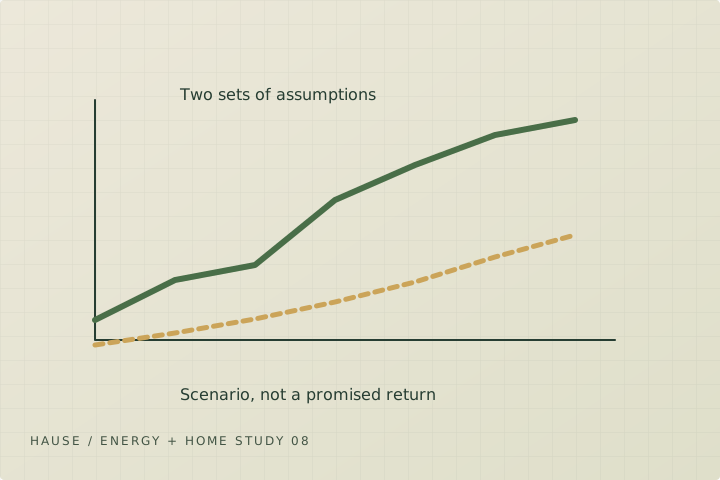
Keep estimated annual energy value separate from the expected utility bill. Fixed charges, imported electricity, financing and future rate changes can all remain. A scenario can help prepare questions; it cannot promise a zero bill.
Sources + further reading
Source review: 2026-10-04. Requirements and programs can change; confirm the current details with the authority or provider.