A simple recovery period divides capital cost by a modelled annual net benefit. That single result hides the assumptions that produced it. Change one assumption at a time so you can see which parts of the proposal matter most and which need stronger evidence before a purchase decision.
Define the cash-purchase baseline
Our simple model subtracts a separately confirmed non-repayable incentive from the entered installed cost, then divides by first-year energy value after an operating allowance. It excludes financing interest, discounting, future price changes, degradation and replacements. Those exclusions are important when interpreting a result that spans many years.
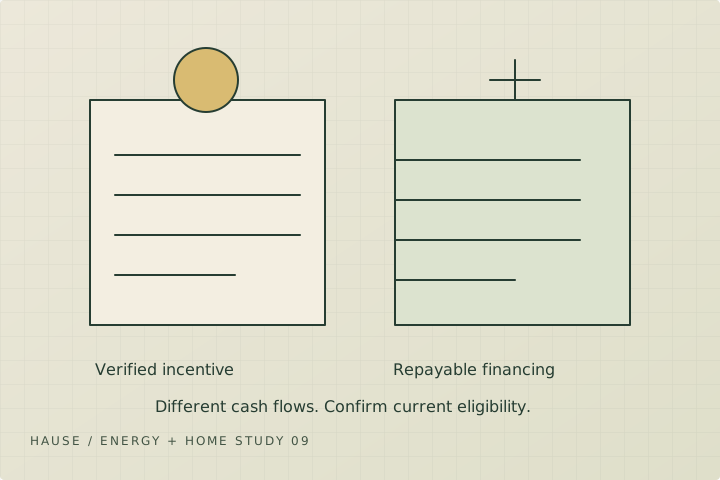
Use the actual installed-cost quote, including applicable taxes and required supporting work. Do not subtract a loan as though it were a grant. If annual net value is zero or negative, there is no simple recovery at those inputs; an infinite or negative payback number would not help the comparison.
Change one assumption, then explain the difference
The table uses a hypothetical $20,000 cash cost, no incentive, $100 annual operating allowance and a $0.14/kWh avoided import-energy value. Its rates and output are examples, not current market terms. The on-site-use fraction means a share of generated energy, with enough annual demand assumed for the cases shown.
| Illustrative case | First-year net value | Simple recovery |
|---|---|---|
| 9,350 kWh; 40% on-site; $0.10 export | $984.60 | 20.3 years |
| 7,500 kWh; same use fraction and rates | $770.00 | 26.0 years |
| 9,350 kWh; 40% on-site; $0.18 export | $1,433.40 | 14.0 years |
| 9,350 kWh; 70% on-site; $0.10 export | $1,096.80 | 18.2 years |
Look for the assumption doing the most work
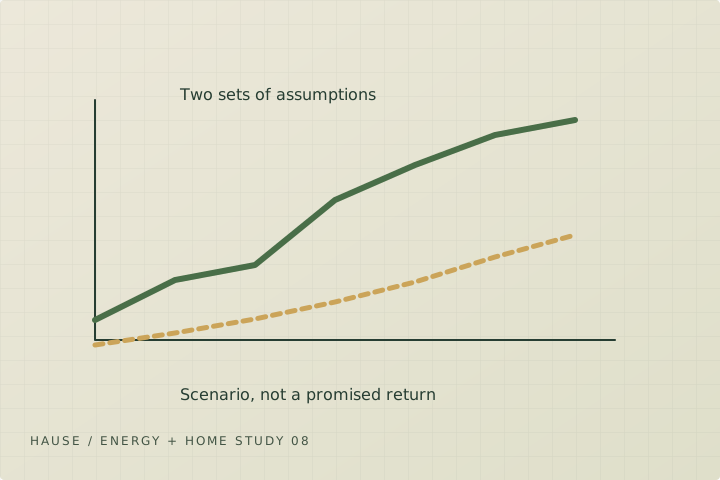
In these examples, a favourable export value changes the result materially. That tells you to read the retailer contract closely and test a less favourable value; it does not predict a future rate. A higher on-site fraction should likewise be supported by load timing rather than selected because it creates an attractive result.
Run a combined conservative case after the individual changes. Lower generation and less favourable rates can occur together. A proposal that remains understandable under that case is easier to assess than one that presents only its best result.
Use a lifecycle model for the final decision
For a major purchase, ask for a model that makes lifetime production, replacement, operating costs, financing and the time value of money explicit. Keep each assumption editable and retain the version used for the decision. Compare the solar project with other uses of the same funds and with your ownership horizon.
Simple recovery can organize questions and expose sensitivity. It cannot promise a break-even year, establish a resale premium or replace the project-specific financial and technical review.
- Capital cost and confirmed incentive recorded separately.
- Rates and yield linked to evidence.
- Individual and combined conservative cases compared.
- Excluded lifetime costs identified.
- Final decision model retained with its assumptions.
Sources + further reading
- City of Calgary: Residential solar collectors
- City of Calgary: Solar photovoltaic permit checklist
- ENMAX Power: Connect a micro-generator
- Alberta Utilities Commission: Rule 024
- Alberta Utilities Commission: Micro-generation FAQs
- Alberta Utilities Consumer Advocate: Micro-generation
- Natural Resources Canada: Solar photovoltaic energy tools
- City of Calgary: Residential solar calculator
- Natural Resources Canada: Closed Canada Greener Homes Grant
- Natural Resources Canada: Closed Canada Greener Homes Loan
- City of Calgary: Residential Clean Energy Improvement Program
- Natural Resources Canada: Planning and decision guide for solar PV systems
Source review: 2026-10-04. Requirements and programs can change; confirm the current details with the authority or provider.